Too many inquiries.
Too little time.
Too many judgment calls.
Too many missed follow-ups.
Every provider described the same frustration:
“We’re getting leads. But we don’t know which ones to prioritise.”
Most of the tools they had tried before focused on answering patient questions faster. Chatbots, autoresponders, and generic lead scoring tools all promised better engagement. But none of them fixed the real bottleneck.
The bottleneck wasn’t engagement.
It was decision-making.
The Real Challenge in Elective Surgery
Elective surgery is not transactional healthcare.
Patients don’t opt for surgery because they received an automated reply. They decide to go ahead because they were contacted at the right time, by the right counsellor, with the right context, in the right emotional state.
But most clinics still run this process on instinct.
Counsellors look at a list of inquiries and make fast, experience-driven guesses:
Who should I call first today?
Who is most likely need my help in decision-making?
Who needs reassurance versus medical input?
Who can wait?
Sometimes they’re right. Sometimes they’re not.
And when you have hundreds of inquiries coming in every week, those missed judgments compound into real revenue leakage and inconsistent patient experience.
This isn’t a chatbot problem.
It’s a decision-support problem.
Why Generic AI Missed the Point
Before building anything, we studied what providers were already using.
- Healthcare chatbots.
- Marketing automation tools.
- Basic AI lead scoring platforms.
They all did one thing well: they generated responses.
They did nothing to improve the counsellor’s actual job: deciding who to engage, when to engage, and why that engagement mattered.
A general-purpose AI model doesn’t understand what a “high-intent patient” actually looks like in elective surgery. It doesn’t know which behavioural signals historically convert. It doesn’t understand readiness, hesitation, emotional context, or operational constraints.
And bolting that model onto a workflow doesn’t magically make it useful.
Our Shift: From Conversations to Decisions
That’s when we stopped thinking about “AI for patients.”
And started thinking about AI for counsellors.
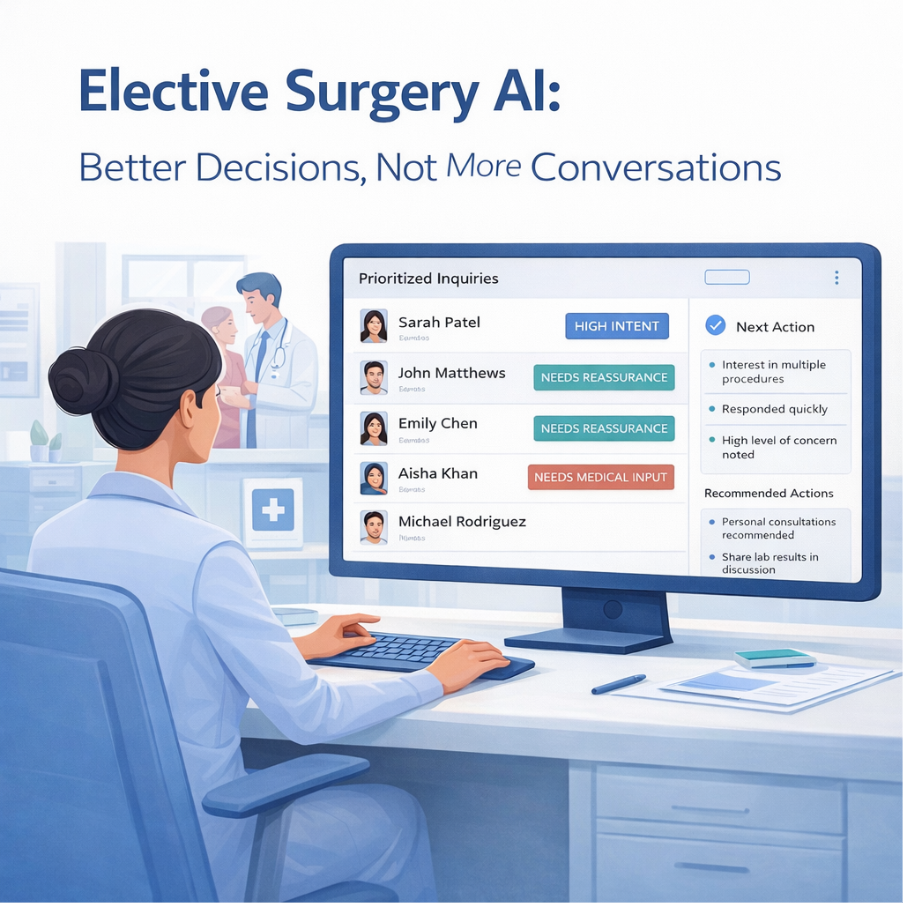
We built Elective Surgery AI as a counsellor-focused intelligence layer that sits inside real workflows.
Instead of answering generic questions, the system:
- Analyses patient intake data and engagement history
- Learns from historical outcomes
- Identifies readiness and likelihood patterns
- Prioritises patients for counsellor action
- Explains why a patient is being recommended
Not to replace counsellors.
To help them decide what to do next.
One counsellor said something during early testing that stuck with us:
“I was going to call this patient anyway. But now I understand why she’s at the top of the list.”
That’s when it clicked.
The value wasn’t that the AI made the decision.
The value was that it made the decision structured, consistent, and explainable.
What It Does (and What It Doesn’t)
From day one, we drew very clear boundaries.
What Elective Surgery AI does:
- Identifies high-likelihood patients
- Prioritises counsellor outreach
- Surfaces readiness and risk signals
- Explains recommendations transparently
- Learns from real counsellor actions
What it does not do:
- Make medical decisions
- Replace doctors or counsellors
- Talk to patients
- Provide non-healthcare responses
It acts as a decision accelerator, not a decision-maker.
In a trust-heavy, regulated environment like healthcare, that distinction is everything.
Why This Approach Works
Elective Surgery AI works not because the model is smarter.
It works because the problem definition is finally right.
It’s built on domain-specific data, not generic datasets.
It’s aligned with real counsellor workflows, not abstract use cases.
It’s designed with human-in-the-loop from day one.
It’s engineered as a production system, not a demo.
The result is simple:
Counsellors spend less time guessing.
And more time engaging the right patients at the right time.
Final Thought
We didn’t build Elective Surgery AI because AI is trendy.
We built it because counsellors were making high-stakes decisions with no structural support.
That’s the real opportunity for AI in healthcare.
Not more conversations.
Better decisions.