
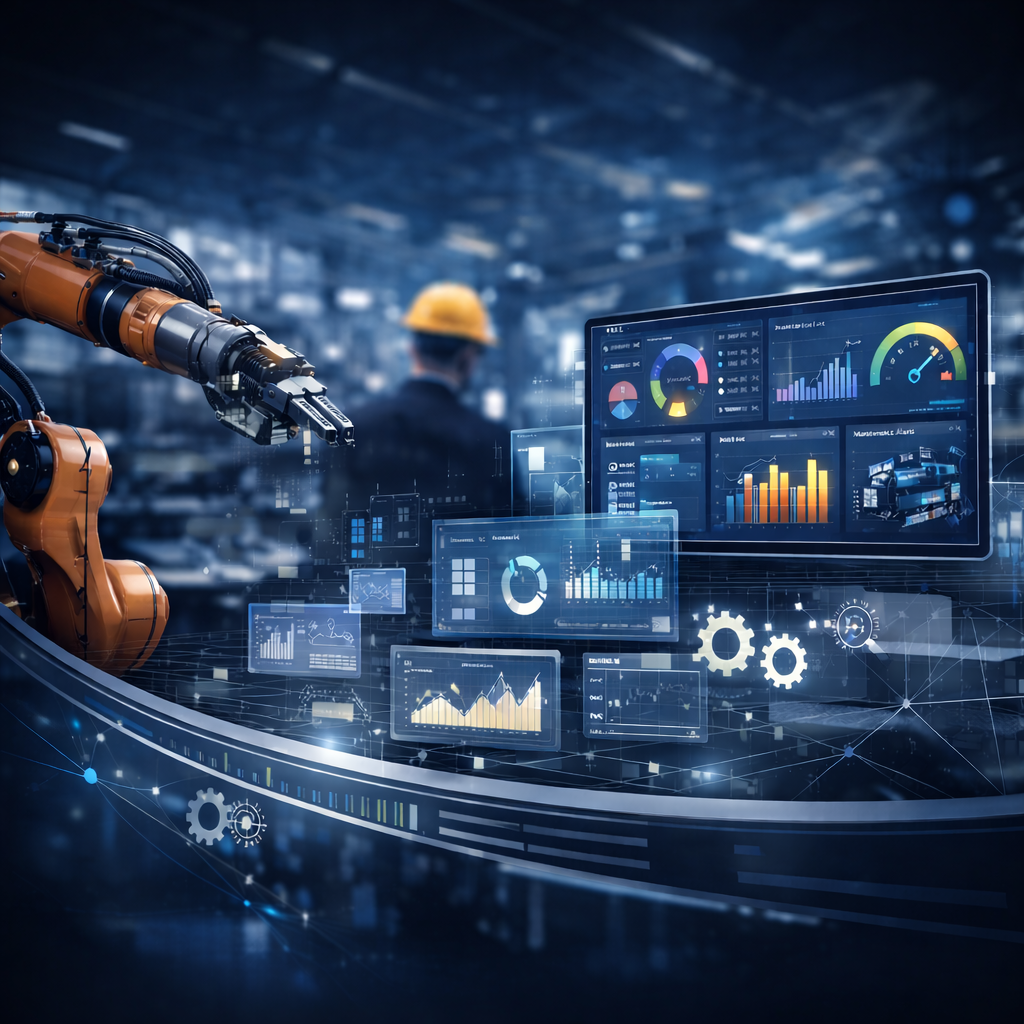
Manufacturing operations today generate more data than ever before. Production metrics flow from machines. ERP systems capture transactions. Quality platforms log deviations. Maintenance systems record interventions.
The constraint is rarely the availability of data. It is how that data moves.
As operations scale across ERP modules, legacy platforms, and departmental tools, reporting often becomes dependent on manual extraction, validation, and reconciliation. What leadership sees reflects processed and dated data, not live activity. Modernization begins when organizations redesign the flow of operational information.
The Limits of Manual Reporting in Manufacturing
Manual reporting rarely breaks outright. It introduces incremental delay that compounds over time.
For one of our trade manufacturing client who was operating on a legacy ERP platform, purchase order volumes increased while entry remained manual. Each transaction required close to sixteen minutes of input effort. At lower volumes, this was manageable. As demand grew, it created a backlog of entry and reporting cycles began trailing operational activity.
Orders were processed correctly. Reports were generated consistently.
But visibility depended on how quickly manual steps could be completed.
The impact is not failure. It is the ‘latency’ a.k.a delay.
By implementing structured extraction and unattended system entry, processing time reduced to under five minutes per order. More importantly, purchase order data entered the ERP system in a standardized format, immediately usable for reporting and tracking.
The shift extended beyond efficiency. Operational data began aligning with real-time activity, reducing lag across dependent systems.When foundational workflows stabilize, reporting accuracy and timeliness improve naturally.
Intelligent Workflows for Manufacturing Automation
As processes intersect across systems, variability increases unless workflow logic is embedded directly into execution.
This became evident within an industrial manufacturing setup managing enquiry-to-quote cycles in SAP. Manual validation introduced fluctuations in turnaround time and inconsistencies in downstream analytics.
Rather than refining reporting outputs, the workflow itself was redesigned. Validation rules were embedded directly into the process. Exception routing was standardized. Manual intervention points were reduced significantly.
With structural logic integrated at the workflow level, quote generation followed predictable pathways and data entered core systems consistently. Downstream analytics reflected stable patterns instead of variability introduced upstream.
Without this foundation, analytics inherits inconsistency. With it, insight becomes dependable.
Automation in this context was not simply an efficiency initiative. It was a structural correction to workflow architecture.
Enabling Manufacturing Analytics Through Automation
Analytics reflects the integrity of its inputs.
Within a discrete manufacturing environment, service ticket management influenced plant stability more than reporting initially suggested. Backlog summaries offered limited insight into current operational conditions.
AI-driven orchestration restructured ticket routing and categorization. Processing efficiency improved significantly, and resolution times declined materially. As structured workflows took hold, reporting began reflecting live workload distribution rather than accumulated backlog.
At this stage, the analytical conversation shifts. Instead of asking “What happened?”, operational leaders begin asking “What is happening now?” and “What is likely to happen next?”
Visibility moves closer to real-time conditions. Decision cycles shorten. Confidence in data increases.
Automation does not replace analytics. It strengthens the foundation upon which analytics depends.
Operational Dashboards for Real-Time Manufacturing Insights
Dashboards are the interface through which insight becomes action, and they reflect the integrity of the workflows beneath them.
Where transaction handling remains manual, dashboards display delay. Where workflows are structured and automated, dashboards surface actionable insight.
In environments where workflow redesign preceded reporting redesign, dashboards evolved from static summaries to operational interfaces. Throughput became dynamic. Exception trends surfaced earlier. Cycle times stabilized.
Dashboards amplify system health. They cannot compensate for fragmented data movement.
Achieving Predictable Manufacturing Operations Through Automation
When automation, analytics, and dashboards operate as connected layers:
- Processing cycles compress.
- Manual effort declines materially.
- Data consistency improves.
- Operational bottlenecks surface earlier.
We have seen transaction times reduced by threefold and manual intervention lowered by up to fifty percent through workflow redesign alone, not through isolated reporting enhancements.
Modernizing manufacturing operations is about predictability.
Predictability develops when workflows are automated, analytics receives structured inputs, and dashboards reflect live operational states rather than reconciled history.
At Newscape, we approach manufacturing modernization by aligning workflow architecture, analytics capability, and operational dashboards into a unified operational framework, enabling real-time decision-making without increasing reporting complexity.