
In a world where data is the new currency, organizations face a familiar paradox.
They have more data than at any point in history, yet converting that data into meaningful insights remains slow, complex, and expensive.
Data lives across multiple systems, clouds, and formats. Traditional approaches like centralizing everything into a single warehouse or lake are powerful, but they demand months of integration work, significant storage investments, and delayed business value.
Recently, Newscape Consulting delivered a Data Virtualization engagement using Denodo for a Life Sciences enterprise. This experience reinforced why this technology is becoming a foundational capability in modern data strategies.
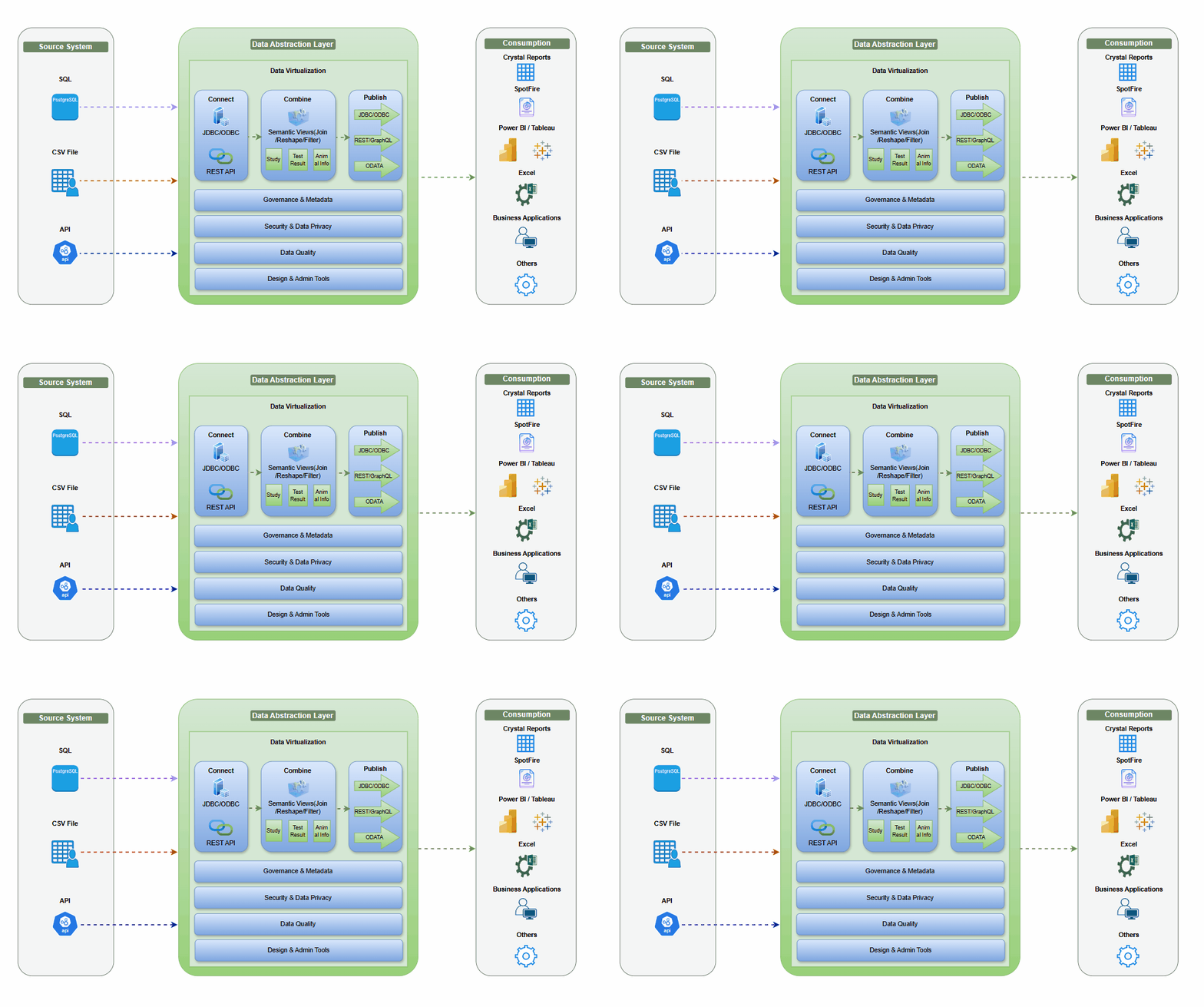
Connecting Distributed Life Sciences Data into a Unified Virtual View
What is Data Virtualization?
Data Virtualization (DV) serves as a unified, intelligent lens across all enterprise data, regardless of its location.
Instead of copying or moving data, DV creates virtual views that combine information from multiple sources in real-time or near real-time. These views apply transformations and present the data to consumers as if it originates from one system.
A Key Advantage: No Data Persistence
One of the most impactful aspects of DV is the absence of data persistence.
This matters because:
- Enterprises already have structured an unstructured data in CRMs, ERPs, transactional systems, data lakes, and cloud applications.
- DV does not require building another warehouse or creating another storage layer.
- Data stays in its original system, maintaining existing security, controls, and compliance policies.
- The DV layer orchestrates access, applies business logic, and serves the data to analytical tools, operational systems, or applications.
This approach leads to:
- Faster time to insight
- Lower storage and infrastructure costs
- Simpler and more consistent governance
Additional Benefits of Data Virtualization
Beyond the advantage of no data duplication, DV enables:
- Agility to onboard new data sources rapidly
- Seamless integration across on-premises, cloud, and SaaS platforms
- A unified and consistent data access layer for BI tools, AI/ML workloads, and operational applications
When Does Data Virtualization Fit Best?
Data Virtualization is particularly effective when:
- Real-time or near-real-time analytics are required from distributed systems
- Data structures and sources frequently change
- Centralizing data is too costly or slow for the business problem
For deep historical analytics or scenarios requiring large-scale transformations, a hybrid approach that combines DV with a warehouse or lake can be more effective.
The Bigger Picture
At Newscape Consulting, our Data and AI practice continues to evaluate and implement modern data technologies that simplify architectures and accelerate business decisions. Across healthcare, life sciences, manufacturing, and other industries, Data Virtualization is emerging as a strategic capability that reduces cost, improves agility, and strengthens governance.
Organizations modernizing their data ecosystems can benefit significantly by incorporating a virtualized data access layer as part of a broader, future-ready data strategy.