
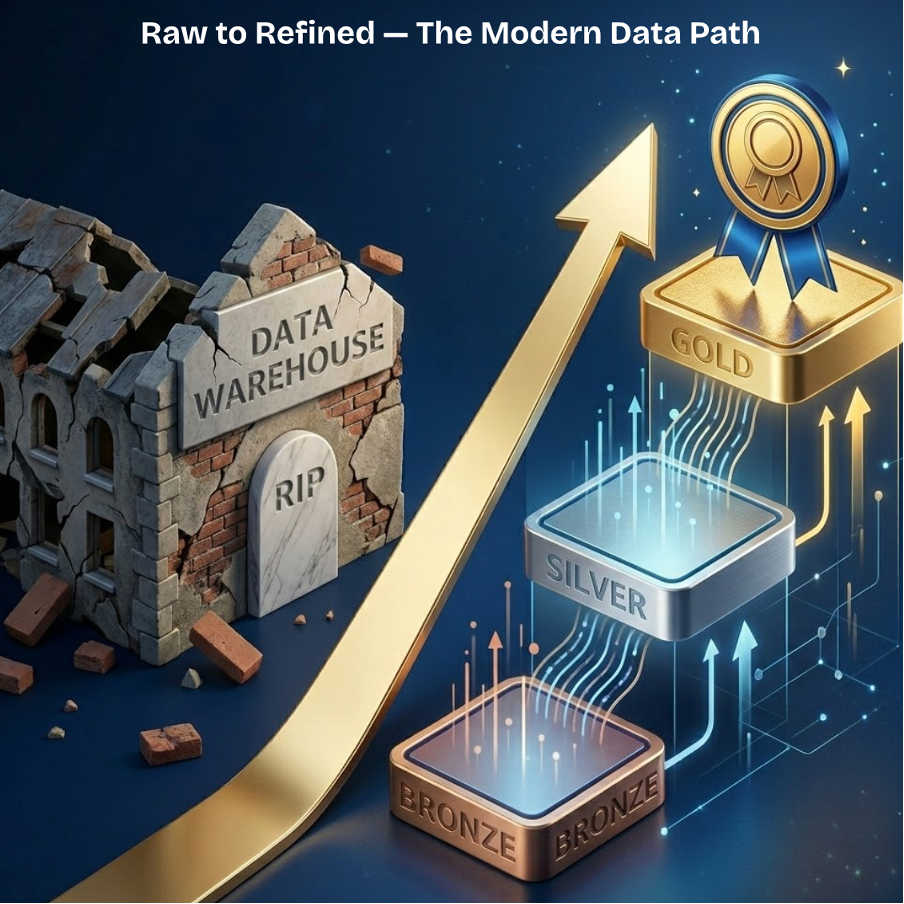
For years, the enterprise data warehouse defined structured analytics. Carefully modelled schemas. Centralized transformations. Clearly governed reporting layers.
It worked, in a world where data was predictable, structured, and primarily batch-driven.
Today, that assumption no longer holds.
Organizations ingest structured, semi-structured, and streaming data simultaneously. Business teams expect faster iteration cycles. Data engineering teams must balance flexibility with governance. Rigid transformation pipelines increasingly struggle to keep pace.
This is why layered data architectures, commonly known as the ‘medallion models’ Bronze → Silver → Gold model are gaining ground.
From Centralized Warehousing to Layered Refinement
Traditional data warehouses emphasize transforming data before it becomes usable. Cleansing, modelling, and structuring typically occur at ingestion. The Medallion approach introduces a different philosophy: allow data to mature progressively.
Instead of forcing heavy transformation right at ingestion, it organizes data into three logical layers:
- Bronze – raw ingestion
- Silver – refined and validated data
- Gold – business-ready datasets
The shift may appear structural, but it fundamentally changes how agility and governance coexist.
Bronze: Preserve First, Transform Later
The Bronze layer captures data as it arrives from source systems; ERP, operational platforms, APIs, or streaming feeds.
Rather than prematurely modelling it, raw fidelity is preserved. This enables lineage, replayability, and schema evolution without breaking downstream processes.
In practice, Bronze layers are commonly used when organizations are integrating multiple operational systems and need a consistent ingestion foundation before downstream modelling begins.
In one enterprise modernization effort we observed, fragmented operational systems were producing inconsistent reporting outputs because each downstream pipeline applied its own transformations. Introducing a centralized raw ingestion layer helped standardize how source data entered the platform, reducing discrepancies across reporting environments.
The value of Bronze is not analytical insight, it is traceability and flexibility.
Silver: Controlled Standardization
The Silver layer introduces structured refinement.
Here, data is cleansed, validated, deduplicated, and aligned to standardized entities. Business rules are applied deliberately, transforming raw operational records into reliable analytical datasets.
This layer is typically where organizations standardize core entities such as customers, products, suppliers, or operational transactions, ensuring consistent definitions across the enterprise.
In the same enterprise platform transformation mentioned earlier, multiple ERP domains contained overlapping master data definitions. By introducing a structured refinement layer, entity standardization and quality checks were centralized rather than repeated across reporting pipelines.
The impact was architectural clarity.
Instead of repeatedly correcting reporting discrepancies, teams refined logic once in the Silver layer and allowed downstream analytics to inherit consistent definitions.
Without this separation, analytics inherits inconsistency. With it, insight becomes dependable.
Gold: Business-Aligned Consumption
The Gold layer represents curated, consumption-ready datasets aligned to business reporting and analytics needs.
At this stage, data is contextualized not just cleaned. Aggregations align to business KPIs, definitions are governed centrally, and data models are optimized for consumption by dashboards, reports, and analytical models.
Gold datasets commonly power executive dashboards, financial reporting, regulatory submissions, and advanced analytics initiatives that rely on trusted business metrics.
In enterprise implementations where layered architectures were introduced, this separation allowed reporting models to remain stable even as ingestion pipelines evolved. Improvements in data quality and consistency were reflected directly in operational and regulatory reporting outcomes.
The architectural discipline of layered refinement, rather than any single technology decision, drove these improvements.
Why the Medallion Model Is Gaining Ground
The Medallion Architecture is not eliminating the data warehouse. It is redefining how analytical data is structured in modern environments.
By separating ingestion, refinement, and consumption:
- Reprocessing becomes feasible
- Schema evolution becomes manageable
- Governance becomes clearer
- Analytical iteration accelerates
- Data quality improves systematically
This layered model aligns naturally with lakehouse environments, but its strength lies in design philosophy rather than platform dependency.
An Architectural Shift, not a Trend
The principle remains unchanged: trusted data drives confident decisions.
What has evolved is how that trust is built.
Layered refinement provides flexibility at the raw layer, discipline at the refinement layer, and stability at the consumption layer, allowing organizations to scale analytics without recreating pipeline fragility.
At Newscape, we help enterprises transition from rigid warehouse-first thinking to layered data architectures that balance agility, governance, and scalability, enabling modern analytics without disrupting core reporting ecosystems.